More of what you generate, used on site
Automation starts immersion heating, EV charging and appliances when surplus is available, so generation offsets purchases instead of being exported cheaply.

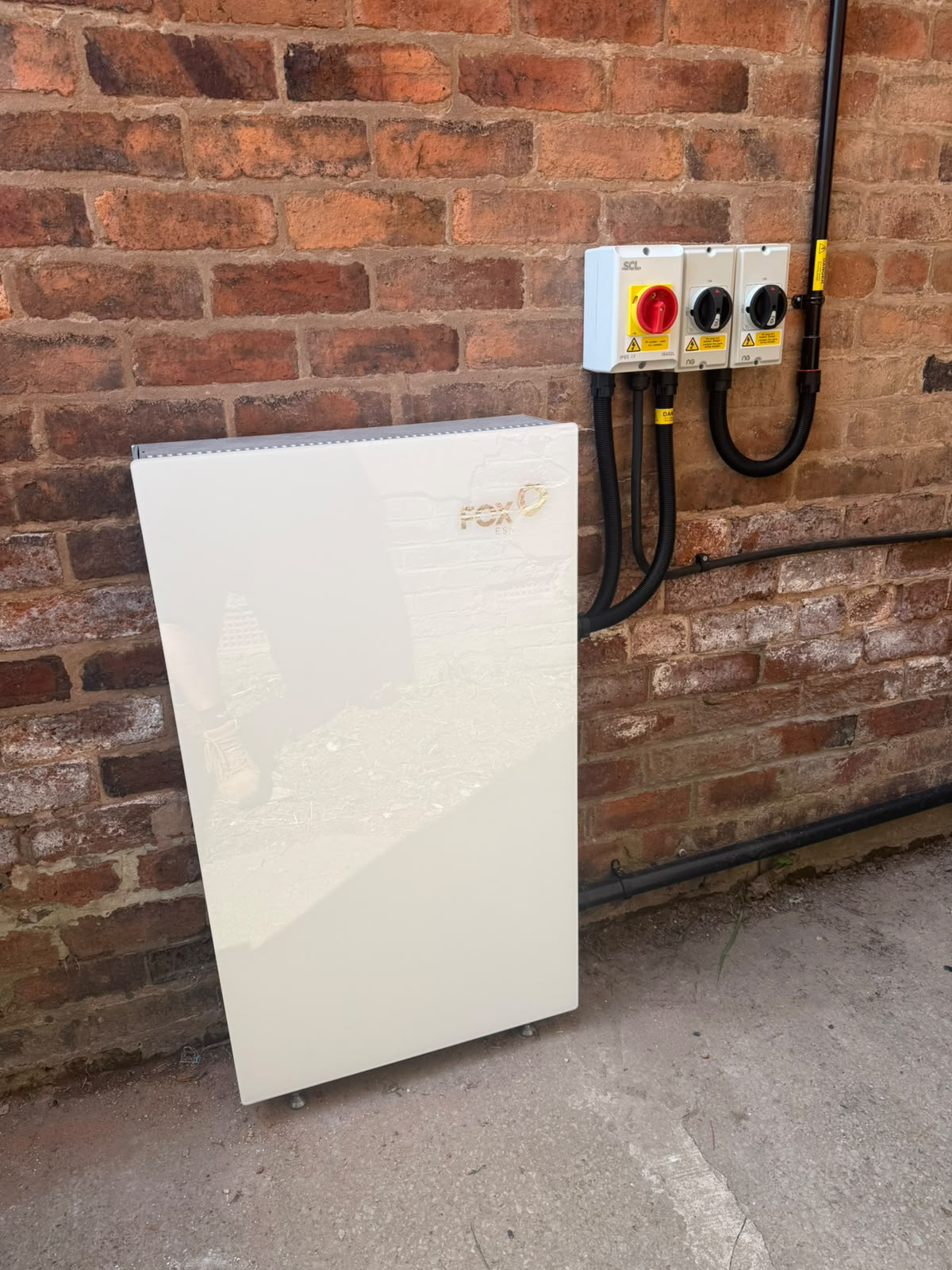
Derby · Generation and storage · MCS in progress
Generation and storage planned alongside your consumer unit, EV charging, heating and automation — so the energy you produce is used where it is worth most instead of exported at the lowest possible value.
MCS accreditation currently in progress · NAPIT Full Scope registered · Free initial consultation and honest advice on timing
16+ years
Domestic, commercial and industrial experience
Full Scope
NAPIT registered for all aspects of electrical work
6-year
NAPIT-backed workmanship guarantee on qualifying installs
£10m
Public and employers' liability cover
Free
Initial consultation, no obligation
The service
Solar PV converts daylight into electricity your property uses first and exports second. Battery storage holds what you do not use at the time and releases it in the evening, or charges from the grid on a cheap overnight tariff to cover the expensive part of the day. Both are straightforward to install and easy to under-use if nothing coordinates them with the rest of the building.
That coordination is where an automation-led contractor changes the outcome. When the control system knows how much is being generated, it can start the immersion, the washing machine or the EV charger while there is surplus, hold the battery for the evening peak, and shift heating recovery into the sunniest part of the day. Without that, surplus goes to export at a fraction of what it saves you when used on site.
We should be straightforward about status: our MCS accreditation is currently in progress. That affects eligibility for certain grant and export schemes, so we will always tell you honestly where that stands at the time of your enquiry and what it means for your options and timing.
What it costs to leave it
The most common disappointment with solar is not the panels — it is the self-consumption rate. A household out at work all day generates most of its electricity when nobody is home, exports it, then buys electricity back at a much higher price at six in the evening. The system works exactly as installed; it simply was never set up to time anything.
Batteries can repeat the same mistake at greater expense. A battery configured only to charge from surplus and discharge on demand ignores tariff structure entirely. On a time-of-use tariff, charging overnight when electricity is cheap and covering the evening peak from storage is often worth more than the surplus it would otherwise capture — but that requires the system to know what the tariff is doing.
There is also the infrastructure question that gets discovered too late. A consumer unit with no spare ways, no space for isolators, or an earthing arrangement that needs attention turns a straightforward installation into additional work. When PV, battery, EV charging and a heat pump are all likely within a few years, the board and the cabling should be planned for all of them at once.
How the job runs
01
We look at the roof, the consumption pattern, the existing board and what else is planned — EV, heat pump, automation — then give an honest view of what is worth doing and when.
02
Array layout and orientation, inverter and battery sizing against your real usage, protection and isolation, cable routes and the control strategy for self-consumption.
03
Board capacity, spare ways, earthing and bonding, isolators and metering positions prepared so the installation lands on infrastructure that is ready for it.
04
Array, inverter, battery, protection and monitoring installed and connected, with generation and consumption metering fed into your control system.
05
System tested and certified, monitoring verified, and automation rules configured so hot water, EV charging and appliances follow surplus rather than the clock.
What you actually get
Automation starts immersion heating, EV charging and appliances when surplus is available, so generation offsets purchases instead of being exported cheaply.
Batteries charged overnight on cheap rates and discharged through the expensive evening peak, rather than reacting only to whatever surplus happens to arrive.
Generation, storage, EV charging and heating designed against the same consumer unit and earthing arrangement, so nothing has to be reworked when the next item is added.
Generation, consumption and battery state shown in the same interface as heating and lighting, with the data used to trigger actions rather than just to be looked at.
MCS accreditation is in progress and we will tell you plainly where that stands and how it affects scheme eligibility for your project.
The electrical installation is carried out and certified under NAPIT Full Scope registration, with £10m public liability cover behind it.
In detail
A generation system's value depends on sizing, shading, protection and control. This is what we assess and specify for properties across Derby, Derbyshire and the East Midlands.
Roof area is a constraint, not a target. We size the array against consumption, orientation and shading, because panels that generate into export at low value add far less than the headline capacity suggests.
Sizing the storage matters more than maximising it. A battery larger than your evening consumption spends most of its life partially used, which is capital doing very little.
This is where an automation contractor adds value that a panel-only installer cannot. Every controllable load in the building becomes a way to use generation rather than export it.
Commercial daytime load profiles frequently suit solar better than domestic ones, because generation and consumption coincide naturally without needing any load shifting at all.
Before you enquire
It depends on array size, roof type, inverter and battery capacity and the state of the existing board, so we do not publish prices. The initial consultation is free and a written quotation follows the design stage.
MCS accreditation is currently in progress. Because that affects eligibility for certain schemes, we will tell you exactly where it stands when you enquire and what it means for your project and its timing.
A typical domestic array with a battery is usually a few days on site once the design is agreed and any board or earthing work is complete. Commercial installations are programmed around your operating hours.
Not necessarily. If your consumption is largely during daylight hours, generation may be well used without storage. A battery is most valuable where evening consumption is high or where a time-of-use tariff makes overnight charging worthwhile.
Yes, and designing them together is the point. Charging and heating can be scheduled to surplus generation or to cheap tariff windows, and the consumer unit is sized for all of it at once.
Panels are long-life items with output declining slowly over decades; inverters and batteries have shorter service lives and are replaceable components. We design the installation so replacing them later is straightforward.
Very little routinely, but monitoring should be watched — a string or optimiser fault can reduce output for months without anything obvious happening. Maintenance packages include remote monitoring checks.
Often, yes — adding storage, improving monitoring, or integrating an existing array into an automation system to raise self-consumption without touching the panels.
Qualifying installation work carries a 6-year NAPIT-backed workmanship guarantee, with a minimum one-year guarantee on other work. Equipment carries its own manufacturer warranties.
Derby, Duffield, Belper, Ilkeston, Long Eaton, Ripley, Ashbourne, Matlock, Burton upon Trent, Nottingham, Chesterfield, Sheffield and the surrounding East Midlands.
Related services
Where we work
Derby · Nottingham · Duffield · Belper · Burton upon Trent · Sheffield · Ilkeston · Long Eaton and the wider East Midlands. See areas covered, read more about the company or return to the homepage.
Book a free consultation and we will tell you honestly what your roof and your consumption pattern justify, where MCS accreditation currently stands, and how it fits with EV and heating plans.
NAPIT Full Scope · Official Loxone Partner · 6-year workmanship guarantee on qualifying installations · £10m public liability