One press starts the film
Lights dim to the cinema scene, blinds close, the screen drops and the source switches from a single keypad or app action — no sequence of remotes to remember.

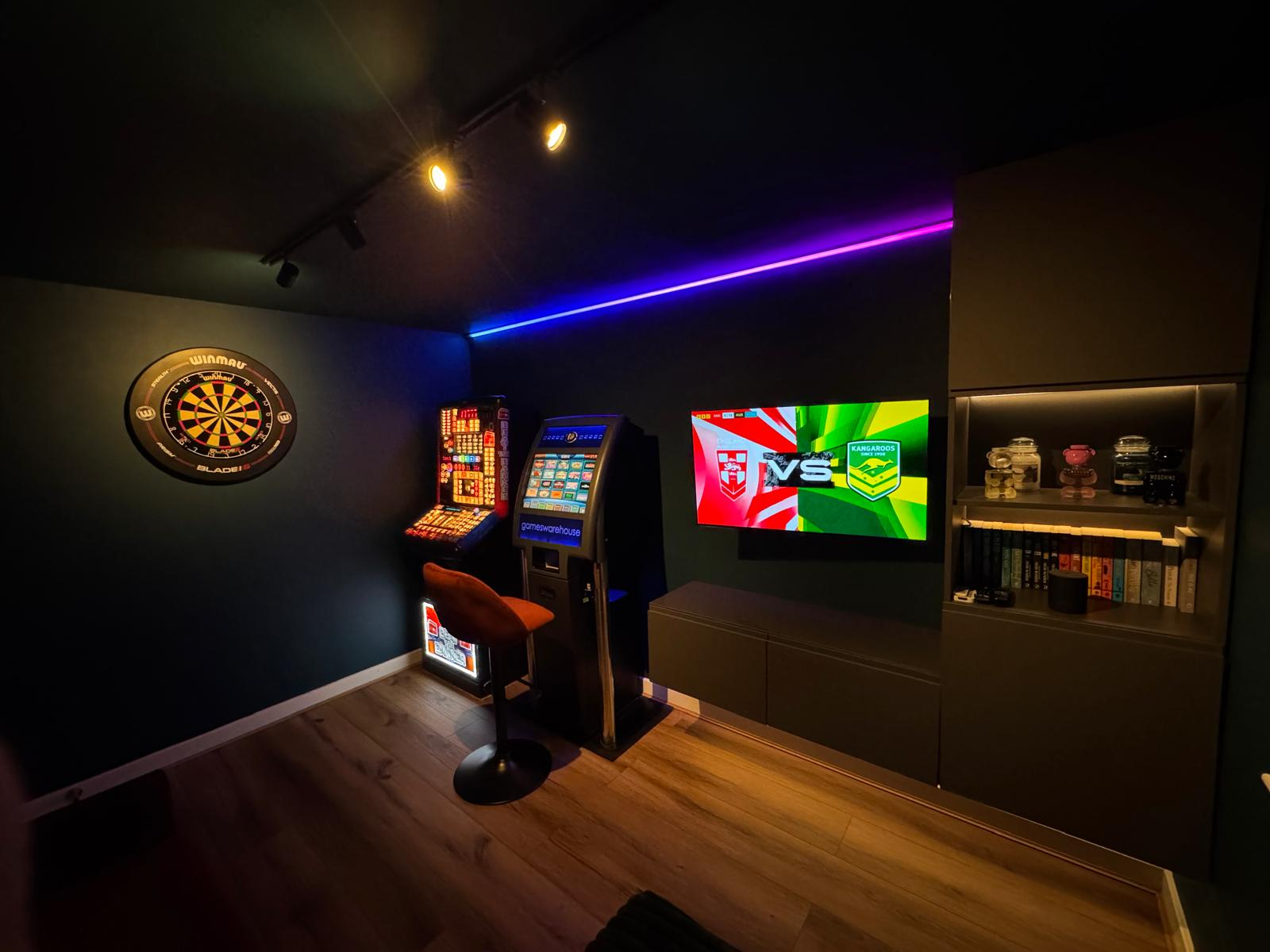
Derby · Cinema, audio and video distribution
Dedicated cinema rooms, discreet multiroom audio and whole-house video distribution — designed at first fix, integrated with your lighting scenes, and commissioned so one press dims the room and starts the film.
Sonos and HD Anywhere integration by an official Loxone Partner · 6-year NAPIT-backed workmanship guarantee on qualifying installations
16+ years
Domestic, commercial and industrial experience
Full Scope
NAPIT registered for all aspects of electrical work
6-year
NAPIT-backed workmanship guarantee on qualifying installs
£10m
Public and employers' liability cover
Free
Initial consultation, no obligation
The service
Home cinema and AV covers three related things: a dedicated cinema or media room with a projector or large display and surround speakers; multiroom audio delivering sound to kitchens, bathrooms, bedrooms, garden and gym; and video distribution that lets any source play on any screen without a stack of boxes under every television.
All three depend on cable that has to be in the walls before the plaster goes on. Speaker runs at the right gauge to ceiling and wall positions, HDMI over structured cabling back to a central rack, mains and data at the projector position, and a rack location with real ventilation. Wireless speakers have their place, but they cannot substitute for infrastructure in a room being built now.
The advantage of an electrical contractor doing this work is that the AV, the lighting and the power are designed as one. The cinema scene dims the lights, closes the blinds, drops the screen and switches the source in one action, because the same team wired and programmed all of it.
What it costs to leave it
AV cabling is the classic thing left until it is too late. Once the ceiling is boarded, skimmed and painted, adding a pair of in-ceiling speakers to the kitchen means access hatches, chases and redecoration. The cable itself is worth very little; the making good afterwards is what costs, and it is entirely avoidable with a plan at first fix.
Compromise then becomes visible and permanent. Surface trunking down a wall to a wall-mounted television, a projector fed by a cable draped across a ceiling, or bookshelf speakers standing in for the in-ceiling pair that were never wired. Each one is a daily reminder in a room that was otherwise finished to a high standard.
Reliability suffers too. Long HDMI runs on unsuitable cable produce intermittent handshake dropouts that only appear when a source changes resolution — a fault that is hard to diagnose and impossible to fix without pulling new cable. Poorly ventilated racks cook equipment and shorten its life. Both are specification failures, not bad luck.
How the job runs
01
We look at the rooms, the seating, the screen or projection position and how you actually watch and listen, then set out what the space can realistically support.
02
Speaker layout, screen or projector geometry, cable schedule, rack elevation, source and control plan, and the lighting scenes the AV system will trigger.
03
Speaker, HDMI-over-structured, data and mains runs installed to every position, along with rack power, ventilation provision and screen or projector fixings.
04
Speakers, displays, projector, screen and rack equipment installed, then levels, distances and picture set up in the finished room rather than left on factory defaults.
05
Control tied into lighting and blinds so one press sets the room, everything demonstrated to the household, and remote support available afterwards.
What you actually get
Lights dim to the cinema scene, blinds close, the screen drops and the source switches from a single keypad or app action — no sequence of remotes to remember.
In-ceiling and in-wall speakers, concealed cable routes and a central rack keep boxes and wiring out of finished rooms entirely.
Video distribution means one set of sources feeds every screen, so you buy and maintain fewer boxes and every television has access to the same content.
HDMI carried over structured cabling with proper extenders removes the handshake dropouts and resolution failures that plague long passive HDMI cables.
Ventilated, accessible racks with managed power and clean cable dressing keep equipment cool and make future upgrades a swap rather than a rebuild.
Qualifying installation work carries a 6-year NAPIT-backed workmanship guarantee, with a minimum one-year guarantee on other work.
In detail
Every AV project reduces to four questions: what goes in the room, what feeds it, where the equipment lives, and how it is controlled. Below is how we answer each of those across cinema, audio and distribution work in the East Midlands.
A cinema room is designed backwards from the seating position. Screen size, viewing distance, speaker angles and sightlines are set first; the equipment list follows from those decisions rather than driving them.
Multiroom audio should be invisible and effortless. Sonos is the most common choice, wired where the building allows because a cabled endpoint never drops out at a party.
Distribution turns a stack of sources into a shared resource. It relies on the structured cabling being right, which is why we design AV and data together rather than as separate packages.
The rack is where AV installations quietly succeed or fail. Heat, poor access and unmanaged power cause most of the faults that get blamed on equipment.
Before you enquire
The range is enormous — a pair of in-ceiling kitchen speakers and a dedicated cinema room with acoustic treatment are entirely different projects. We do not publish prices for that reason. The consultation is free and a written quotation follows.
First fix cabling for a whole house is typically a few days within the build programme. A dedicated cinema room install and calibration usually takes several days once the room is finished and decorated.
Frequently, yes, where loft or floor void routes exist. We will be straight with you at the consultation about which rooms can be reached cleanly and which would need making good afterwards.
No. Plenty of clients run a media setup in a living room with controlled lighting and blinds. A dedicated room simply removes the compromises around light control, speaker placement and acoustics.
Yes. Sources are centralised in the rack and distributed to the screens that need them, with control unified so switching between them does not mean changing remote.
Cabling, speakers and screens are long-life items; source devices and streaming boxes change fastest. Designing around a central rack means upgrading a source is a swap rather than a re-install.
Yes, and it is the main reason to have one contractor doing both. A single scene can dim the lights, close blinds, lower the screen and select the source.
Yes. Remote and in-person maintenance packages are available, and most configuration changes are handled remotely without a site visit.
Qualifying installation work carries a 6-year workmanship guarantee backed by NAPIT, with a minimum one-year guarantee on other work. We hold £10m public liability and £10m employers' liability cover.
Derby, Duffield, Belper, Ilkeston, Long Eaton, Ripley, Ashbourne, Matlock, Burton upon Trent, Nottingham, Chesterfield, Sheffield and the surrounding East Midlands.
Related services
Where we work
Derby · Nottingham · Duffield · Belper · Burton upon Trent · Sheffield · Ilkeston · Long Eaton and the wider East Midlands. See areas covered, read more about the company or return to the homepage.
Book a free consultation and we will map the speaker, screen and rack positions your rooms need — before the plasterer makes them expensive.
NAPIT Full Scope · Official Loxone Partner · 6-year workmanship guarantee on qualifying installations · £10m public liability